
← Case studies page
UX Research
Impact
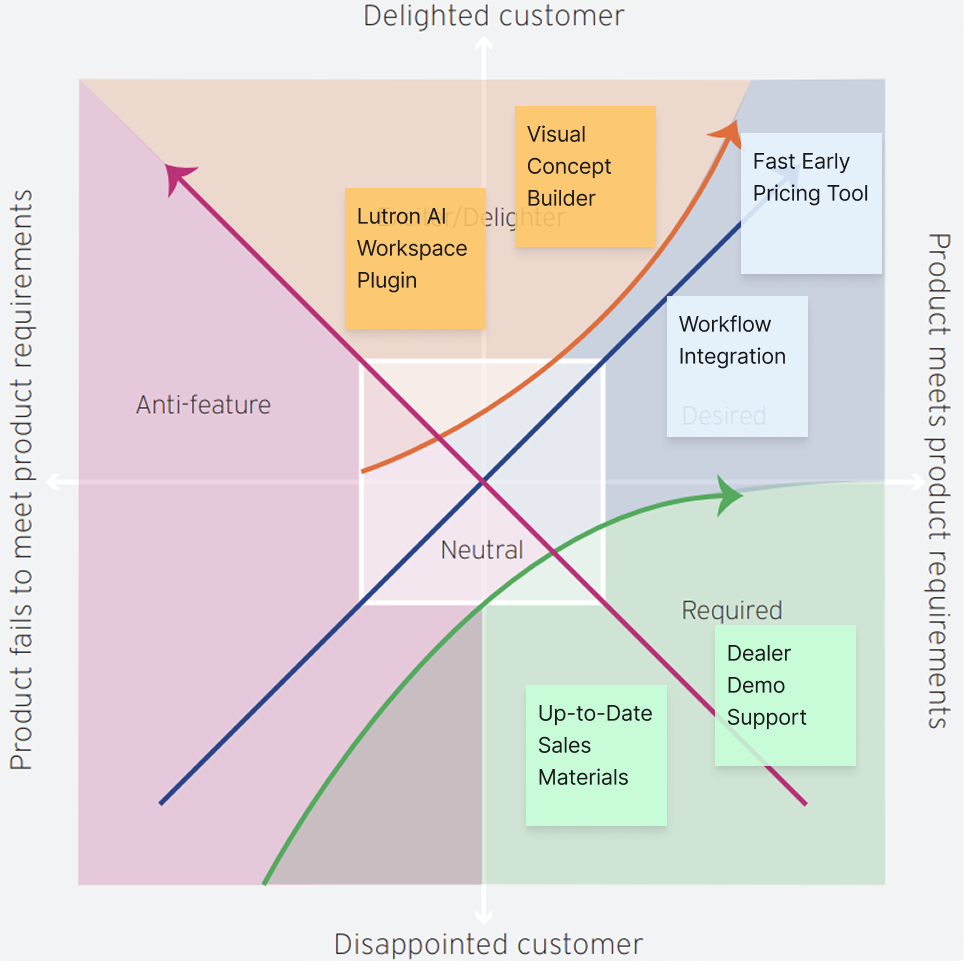
The research showed that dealers need credible early pricing and more connected workflows to move projects forward with confidence.
It also highlighted the value of visualization and in-person demos.
These findings helped stakeholders focus discussions about future presales concepts.
The earliest conversation decides whether there is a project at all.
Residential lighting dealers often piece together presales work across tools such as MyProjects, D-Tools, Lutron Designer, spreadsheets, PDFs, and presentations.
Before a residential dealer can sell a Lutron system, they have to get a homeowner from curiosity to commitment. That early stretch runs on the dealer’s own time and judgment. The client asks “how much?” before features come up, interior designers can filter the idea out, and lighting scenes are hard to describe in words.
The team knew dealers found presales hard but did not know where the drag actually was.
It could have been a pricing problem, a visualization problem, a demo access problem, or a workflow problem, and each would lead to a very different product investment.
As a residential lighting dealer,
I want to explain the value of a Lutron system and set credible expectations early,
so that the homeowner can decide whether to move forward.
Framed four testable hypotheses with product partners so the study would end in a prioritization decision rather than a list of pains.Designed the interview protocol, including a confidence pulse check and a “divide the bill” forced-budget exercise.Moderated sessions with seven residential dealers.Synthesized an empathy map, a five-stage presales journey, and a Kano classification of six candidate investments.
Stakeholders didn’t need a longer list of dealer pains. They needed evidence to choose between competing bets on presales, each with a different owner and cost. I set the study up around those decisions and checked each method against one.
Know where presales actually stalls: pricing, visualization, demos, or workflow
Understand where in the sale each investment would help
Choose among six candidate investments, not just rank complaints
Interviews on their own tend to produce a list of everything that hurts. I wanted the study to separate what dealers complain about from what they would invest in, so each method was chosen to narrow the question.
01 · Hypotheses
Four bets up front
Pricing vs. visualization, speed vs. accuracy, physical vs. digital demos, fragmented workflow vs. missing tools. Each was graded after synthesis.
Dealers struggle with presales due to lack of fast, credible early pricing not insufficient visualization.
Rapid design and pricing tools will increase dealer confidence and speed in closing deals.
Physical, real-world demos build more client confidence, but digital visualization tools also add great value
Presales efficiency is constrained more by fragmented workflows than by a lack of tools
02· User Interview
7 residential dealers
Walkthroughs of recent presales conversations, the tools they used, and where deals stalled.
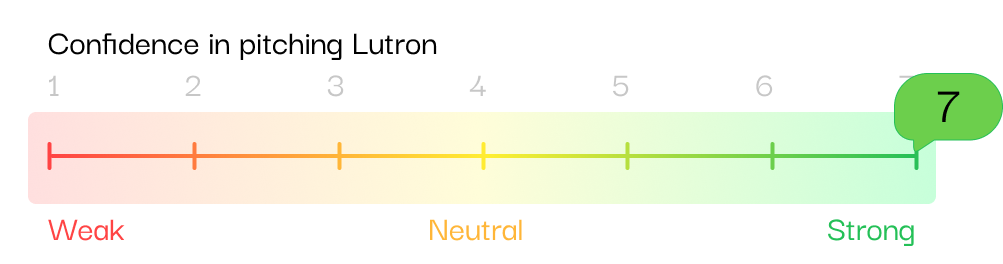
PULSE CHECK
A baseline read of how confident dealers feel pitching Lutron today, to separate brand confidence from process pain.
DIVIDE THE BILL
A baseline read of how confident dealers feel pitching Lutron today, to separate brand confidence from process pain.
01 · Hypotheses
Four bets up front
Pricing vs. visualization, speed vs. accuracy, physical vs. digital demos, fragmented workflow vs. missing tools. Each was graded after synthesis.
02 · Interviews
7 residential dealers
Walkthroughs of recent presales conversations, the tools they used, and where deals stalled.
03 · Pulse check
Confidence on a 1–7 scale
A baseline read of how confident dealers feel pitching Lutron today, to separate brand confidence from process pain.
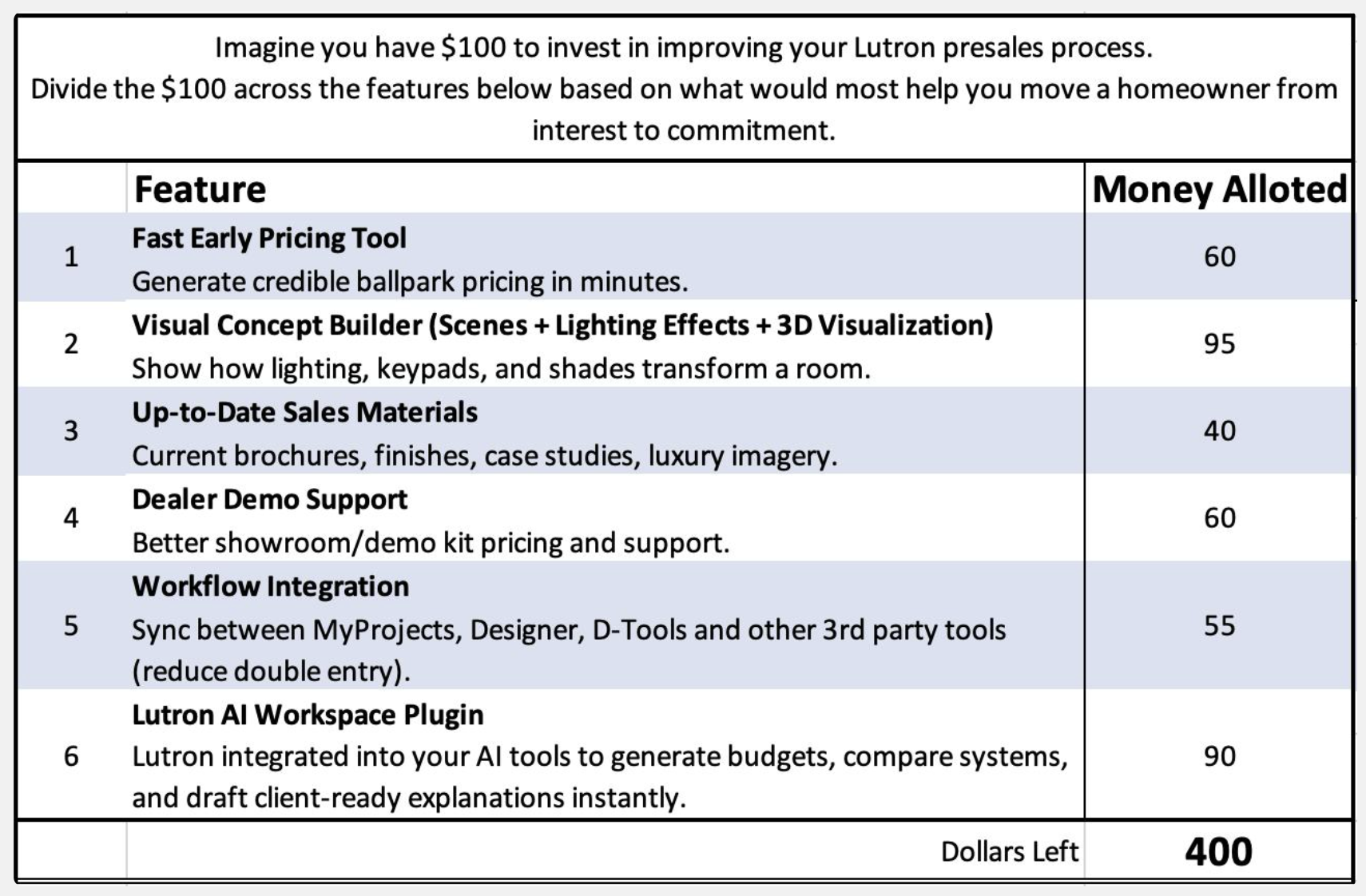
04 · Divide the bill
$100 to invest
Participants split $100 across six candidate improvements, forcing trade-offs a rating scale can’t.
05 · Synthesis
Empathy map and journey
Hears / sees / says / thinks, plus pains and workarounds across five presales stages.
06 · Prioritization
Kano analysis
Sorted the six feature suggestion into must-haves, performance drivers, and differentiators.
Lutron has just become synonymous with lighting control in the design community.
The pulse check pointed to strong confidence in pitching Lutron, and the empathy map said the same: dealers feel very confident in the product and brand.
Their frustration is with budget objections, designer gatekeeping, and time spent on proposals that may never close. They protect their time and are wary of design effort that goes nowhere.
This mattered for scoping.
The opportunity was not to make dealers believe in Lutron. It was to cut the cost and risk of the work they do before a client commits.
Constant efficient communication is key to the success of any project that I am a part of. I try to keep everybody - Supervisors, Stakeholders and the whole team in the loop with what I am doing. I ask as many questions as I can until I understand the topic handed to me. My ability to communicate design decisions reveals my mentality, shows stakeholders I am trustworthy, and proves I can successfully perform the task. Hence I try my best at all times to communicate my thoughts and decisions to everybody involved.
I do my best work with instant feedback because I get to pause, engage, modify my behaviour and reiterate at the moment while the work is still fresh. It blows my mind every time when I get a fresh point of view from a round of critiques from the team on how every person tackles and views a problem in a different way.
By receiving regular feedback, I am incentivised to improve performance and attainment, resulting in self-motivated learning.
The data from my research drives every decision I make. I base all off my recommendations based off the comprehensive user research that I've conducted or been a part of. The knowledge I have gained from my background in software engineering, graphic design, and digital marketing also helps me make logical and feasible decisions.
It is imperative to me to have an organized file structure, no matter what format they are in, whether they are documents, posts on Miro, or boards on Figma. It not only has made my work easier, but it also helps other collaborators to browse through my work for a task.
My preference is to have quick tag-ups with the teams that I am involved with to maximize productivity, reinforce shared goals, and conserve time.
It's always been my approach to stay three steps ahead of any situation and to develop solid plans to follow through. Those skills have improved significantly over the past 10 weeks of my summer internship and I try my best to be as novel and creative as I can with these plans of mine.
Moreover, I have also discovered the importance of making impromptu plans as well as planned ones during a design cycle. I have a better understanding of how to gather my resources and skill sets to conceive creative solutions to real-world problems. I hope this post has reflected my approach to solving contemporary problems moving forward while working as a designer.